

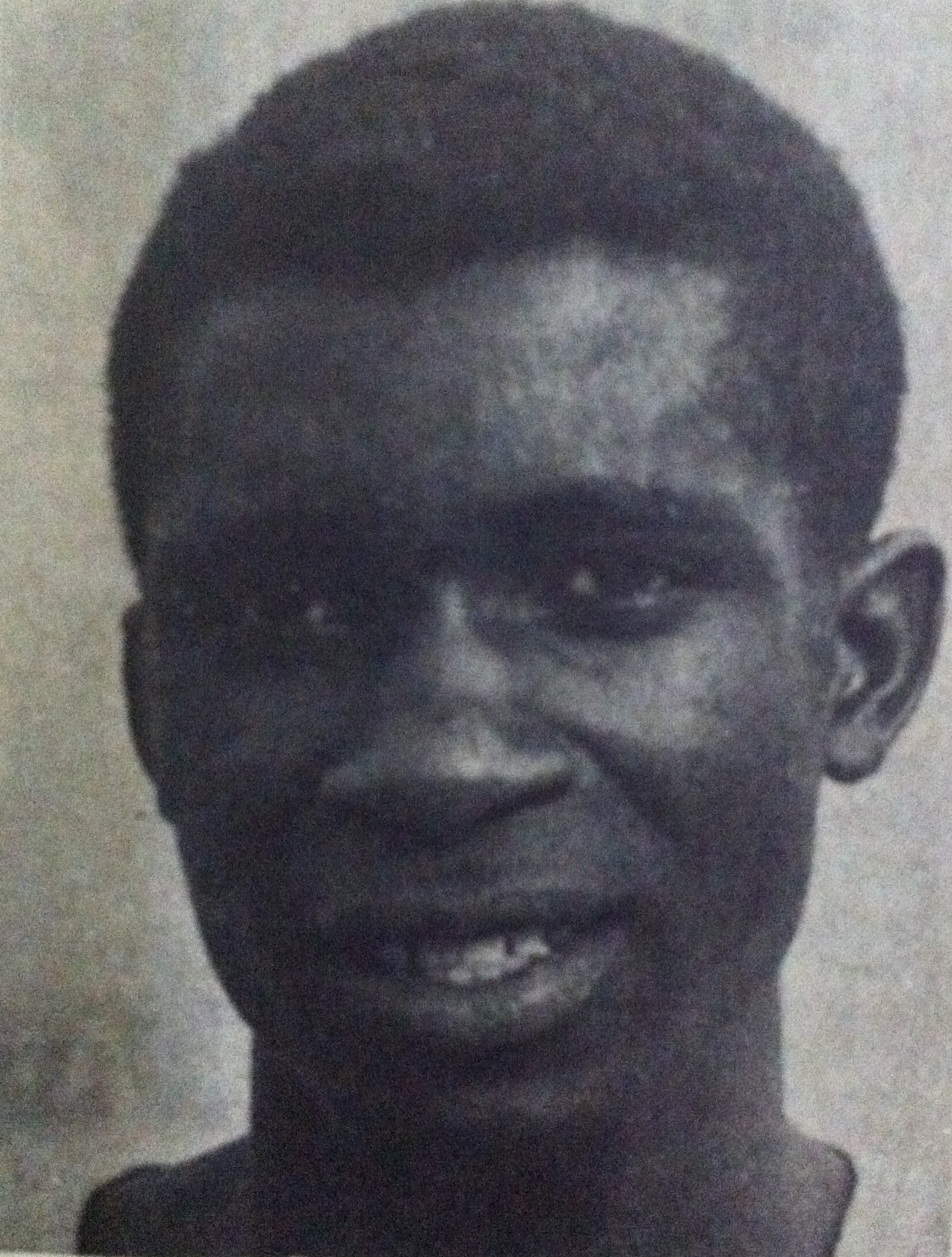
|By Jerry Muchimba, Renowned Zambian football historian and author|
Zambia hosted Kenya again for the Rothmans’ International Trophy in September of 1965 and Kunda was entrusted with number nine shirt once more. He held his own alongside veterans Zoom, Sewell and Emment Kapengwe, and scored once in the three-match series as Zambia emerged victorious.
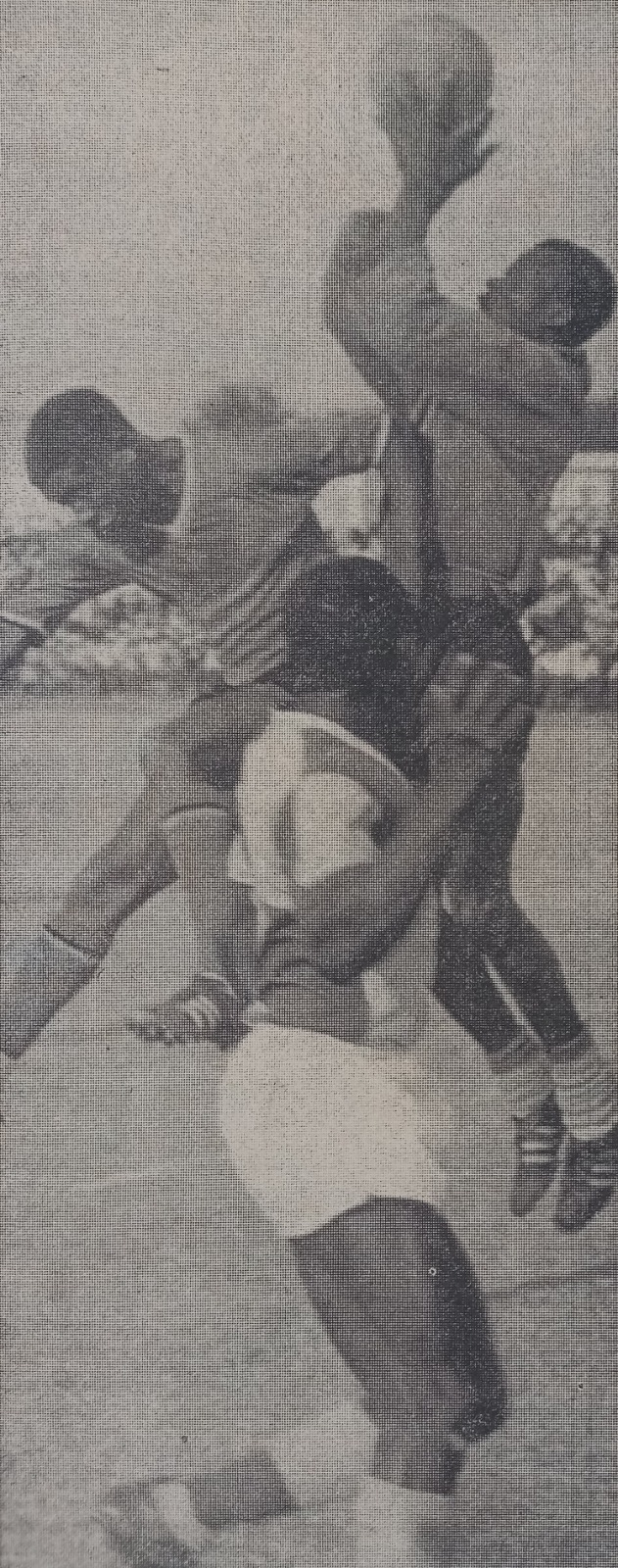
| Kunda challenges Kenya’s goalkeeper Fred Otieno as centre-back John Otieno watches, during the Rothmans International Trophy series in September 1965. The match took place at the Dag Hammarskjöld Stadium in Ndola and ended in a 3-3 draw. |
Kunda also scored twice in two matches against the touring Middlesex Wanderers in June 1965 and another two against Ugandan provincial side Busoga in October of the same year when Zambia travelled to Uganda, and won 4-2, having earlier drawn against the Uganda Cranes two days earlier. This proved to be his last outing with the national team.
1965 was a great year for Wanderers as they reclaimed the league from City of Lusaka and added the Heinrich Cup, the Castle Cup and the Inter-Rhodesia Castle Cup, and just missed out on the Challenge Cup.
The Inter-Rhodesia or ‘Super’ Castle Cup had eluded Zambian clubs from 1962 when Roan United lost to Bulawayo Rovers 1-0 and Mufulira Blackpool were defeated by Salisbury Callies 0-2 the following year. There was no match up in 1964 due to Zambia’s independence celebrations but with Wanderers earning the right to take part by winning the Zambian Castle Cup, when they beat City of Lusaka 5-2 after extra-time in September 1965 with Kunda scoring a hattrick, they became the latest Zambian club to try and bring the coveted trophy home. Their opponents were City Wanderers of Salisbury. Beside the prize money on offer, the match carried extra motivation as a decision had been made to do away with the competition by having one last final after which the winners would keep the trophy for good.
When the game kicked off at Glamis Stadium on 17th October 1965, Wanderers took control and Mwale opened the scoring after five minutes. Kunda, who was 19 and still a schoolboy, scored Wanderers’ second goal when he volleyed Ken Simwanza’s cross just inside the post on 17 minutes. Ndhlovu soon made it three-nil but the home team reduced the arrears through Makoni on 30 minutes, for a 1-3 halftime scoreline. Despite a rally by the Southern Rhodesians, who drew level to take the match into extra time, another goal by Mwale saw Wanderers carry the day on a 4-3 scoreline and return home with the trophy.
At the end of the season Kunda was top scorer once again and looked set to dominate the Zambian scoring charts for years to come. When asked what made a good centre-forward, Kunda said an effective centre-forward needed to know how to position himself strategically between the insiders, halfbacks and wingers, and needed to use his skill, speed and think quickly while in possession of the ball, and that he also needed to be good at reading the game and spotting the opposition’s weaknesses, particularly those of the goalkeeper. On the origin of his nickname, he disclosed that he did not know where the name ‘Orlando’ came from but he recalled that his teammate Sandford Mvula was also called the same name but it stuck on him.
By 1966, Kunda had completed school and he started working for Mufulira Mine as a records clerk. He began the 1966 season in fine form, and had scored 15 goals when midway through the 1966 season, misfortune struck. Wanderers faced Kabwe Warriors in a match at Shinde stadium and with the home side leading 4-2 after four goals by Kunda, a Wanderers’ attack saw a cross being swung into the Warriors’ goal mouth and Kunda and Kenneth Simwanza both went for the ball and ended up colliding. Kunda suffered a broken nose and from then on bled profusely whenever he tried to play and was compelled to retire prematurely.
In his time at Shinde, he won the league three times (1963, 1965, 1966), the Castle Cup (1965, 1966), the Heinrich Cup (1964, 1965) and the Super Castle Cup (1965).
Soon after suffering the broken nose, he quit his job at Mufulira Mine. It was a sad ending to a very promising career but the injury was not the only reason why he quit football. What fans did not know was that Kunda had been having psychological problems. According to sources from Mufulira, Kunda had a lot of girlfriends and when one of them fell pregnant, he denied being responsible. The girl’s father was a Malawian who had come to Zambia to work in the mines and was said to have been very upset with Kunda shirking his responsibility, so many believed he used some charms to get back at Kunda, and that was the source of his mental health issues.
Kunda left Mufulira and travelled to Mansa to seek a traditional cure in 1967. His fans were excited when he mulled a comeback for Wanderers in March 1967 and again in December 1969 but nothing came of these attempts as he was still experiencing psychological problems.
He ended up leaving Mufulira to go and live with his mother and step-father in Chalamalawa’s Village in Chief Mbumba’s area near Mansa and his former teammates shared that he seemed alright when he was far from Mufulira yet when he tried to return to the town, the psychological problems returned as soon as he crossed Chembe Bridge.
In 1971, Kunda attempted to resume his playing career when he joined lower league Mansa Wanderers. He disclosed that he planned to coach the side as well and that he would not be returning to Mufulira but would settle in Mansa. Once again, his comeback failed to take off.
Years later in September 1986, an article in the Times of Zambia brought to light Kunda’s plight where he was still living with his mother and step-father and was often seen walking around the streets of Mansa barefoot. He appealed to his friends in Mufulira to send him clothes, and claimed that Wanderers only gave him K56 when he left Mufulira to go and settle in the village after his parents were pensioned off and the only support he got was from his brother Thomas Bwalya who also played for Wanderers and in contrast, had a long career at Wanderers.
The article dispelled reports that he was living like a tramp and his mother affirmed that the problem was that he had no clothes, especially shoes, and told the reporter to ask Kunda’s friends in Mufulira to send him some. Officials at Wanderers made plans to organize a benefit match for Kunda, whose proceeds would be handed over to their former striker, but the match never took place.
Kunda lived the rest of his life in the village and died in December 2007 after illness.




Thank you for the article, and terrible ending to ba Willie Kunda. I remember watching Mufulira Wanderers playing against Mufulira Blackpool at Dag Hammarskjöld Stadium (populary known as pa Dag). I was a small boy but I remember Zoom because the whole stadium went Zoom whenever, he touched the ball. I am sure Willie Kunda as there as well but overshadowed by Zoom, and “Mosquito legs”
If possible, do another article on Peter “King” Mhango, the best header of the ball in Zambian football. He played for City of Lusaka